2023
Intuit Account Recommendation Redesign Using AI/ML Innovation
I Led the end-to-end design strategy for Intuit’s first AI-powered account recommendation experience, transforming the platform from static, rule-based prompts to adaptive, personalized guidance. I defined the core recommendation framework, secured cross-functional alignment, and established the design principles that now serve as the standard for all future account recommendations within the Intuit Account Manager.
This work drove a 5% lift in task completion within 60 days of launch, reduced customer frustration from repetitive prompts, and increased completion of high-value identity tasks. The outcomes informed the company’s long-term recommendation strategy—now influencing 21M+ annual Intuit Account visits—and set foundational principles for how AI/ML recommendations are framed, explained, and validated across customer workflows.
My Role: Senior Product Designer — Intuit Platform & Identity Team
Collaborators: Engineering, Research, Data Science, Intuit Identity PM Leaders

The The Intuit Identity Platform
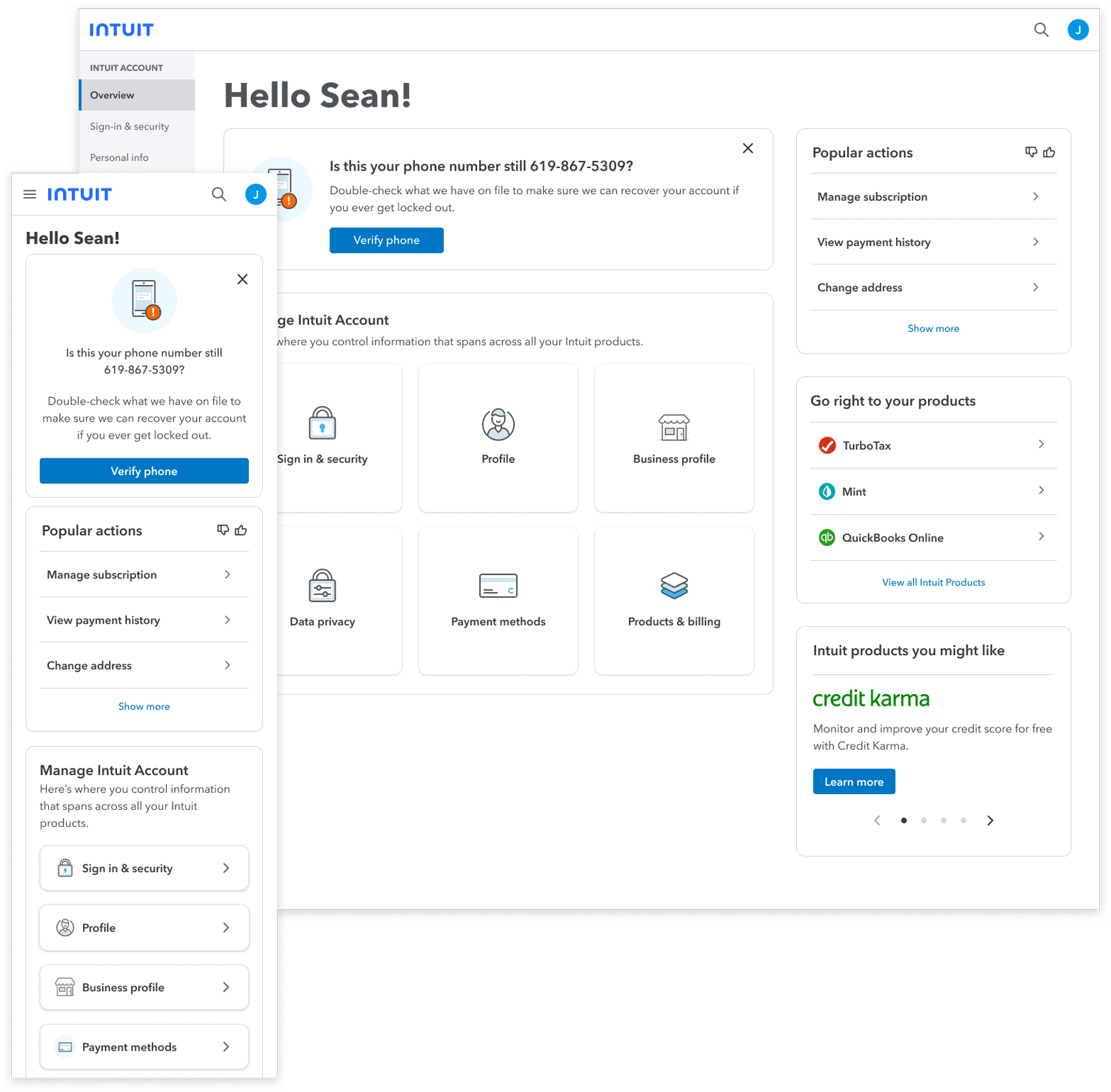
The Intuit Account Manager platform empowers customers to manage their data across various Intuit products they use. It serves as a collaborative platform where identity management capabilities are contributed to provide customers with functionalities such as managing payment methods, sign-in and security, profile management, and more.
Customer Insight Informing Our Work
Feedback from over 140,000 customers states that they see the same account prompts repeatedly, even if they did not apply to them. This created frustration and reduced trust in account-level messaging. At the same time, the business needed a scalable, intelligent way to surface the right actions to customers across millions of account sessions—without increasing friction or requiring manual targeting rules.
Team Opportunity
How might we use AI to help customers complete the right tasks at the right time?
Intuit is prioritizing an AI-driven future, encouraging designers to identify opportunities where intelligence can enhance customer experiences. This shift enables the Platform team to move from rigid, rule-based logic to adaptive, data-driven models that learn from real behavior—allowing recommendations to evolve rather than remain fixed.
Problem Space
“I want guidance that actually applies to me—not generic reminders I start to ignore.”
Customers often saw the same account prompts repeatedly, even if they did not apply to them. This created frustration and reduced trust in account-level messaging.
At the same time, the business needed a scalable, intelligent way to surface the right actions to customers across millions of account sessions—without increasing friction or requiring manual targeting rules.
How I Collaborated With Stakeholders
Design Process
Data Engineering Capabilities
Worked closely with data science to understand how the model made recommendations and where it could be inaccurate. This helped ensure the experience was clear, trustworthy, and not misleading to customers.
Recommendation Framework Definition
I created a structured system for how recommendations should appear based on themes I surfaced from customer VOC and how messaging adapts based on user signals. This framework later scaled to additional account tasks I designed.
Picked One Task Recommendation - To Test To Validate
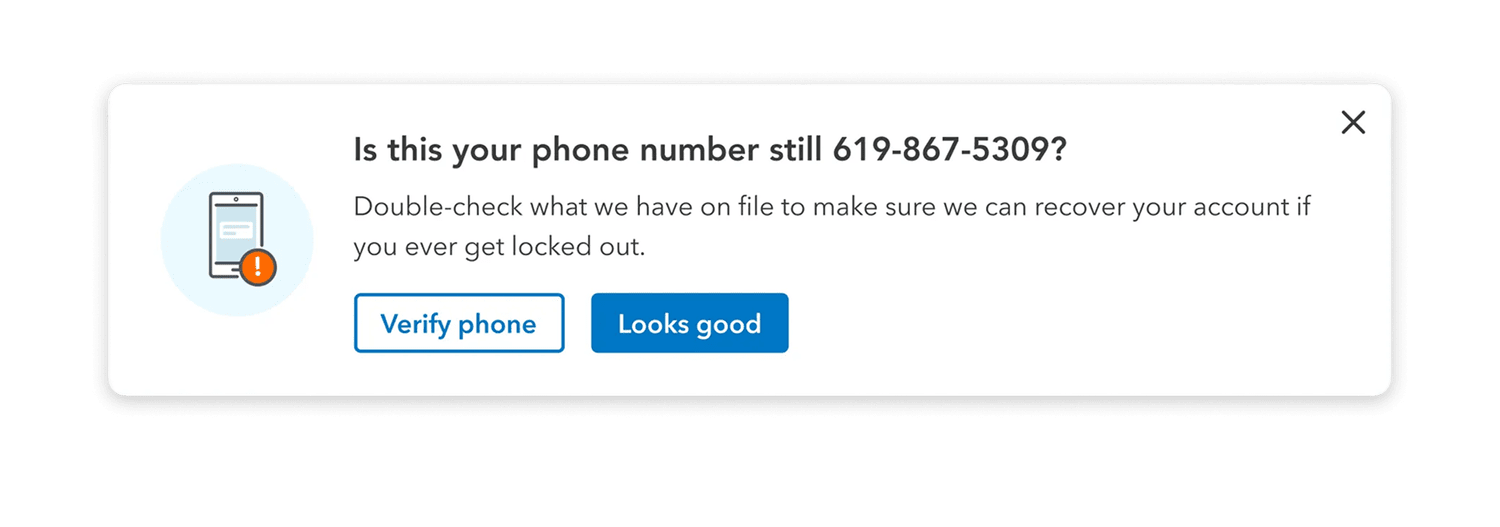
We tested three messaging tones, trust-focused content cues, and visual hierarchy for the recommendation task—because updating a phone number is a high-value action tied to sign-in, identity, and security
Pilot Launch + Measurement
Launched with a focused pilot audience to measure real-world interaction patterns and optimize before broader rollout.
The Framework I Designed & Proposed
Proposed Recommendation Framework
We used Voice-of-Customer insights to identify the most common account tasks and grouped them into a set of simple, meaningful themes. I partnered with a Senior Content Designer to ensure the framework was easy to understand and supported clear, consistent messaging.
Critical Tasks
If the customer doesn’t take action will this compromise their security or identity?
Celebrating Milestones
If something is achived are we taking time to engage in celebratory moments?
Product Features Not Being Utilized
If the customer isn't aware of a feature and its benefit did we inform them?
First-Time Customers
If I'm new to Intuit what tasks should I be handling first before all others?
Support Retention & Revenue
What tasks do I need to complete to prevent disruption of product use
Design Deliverables
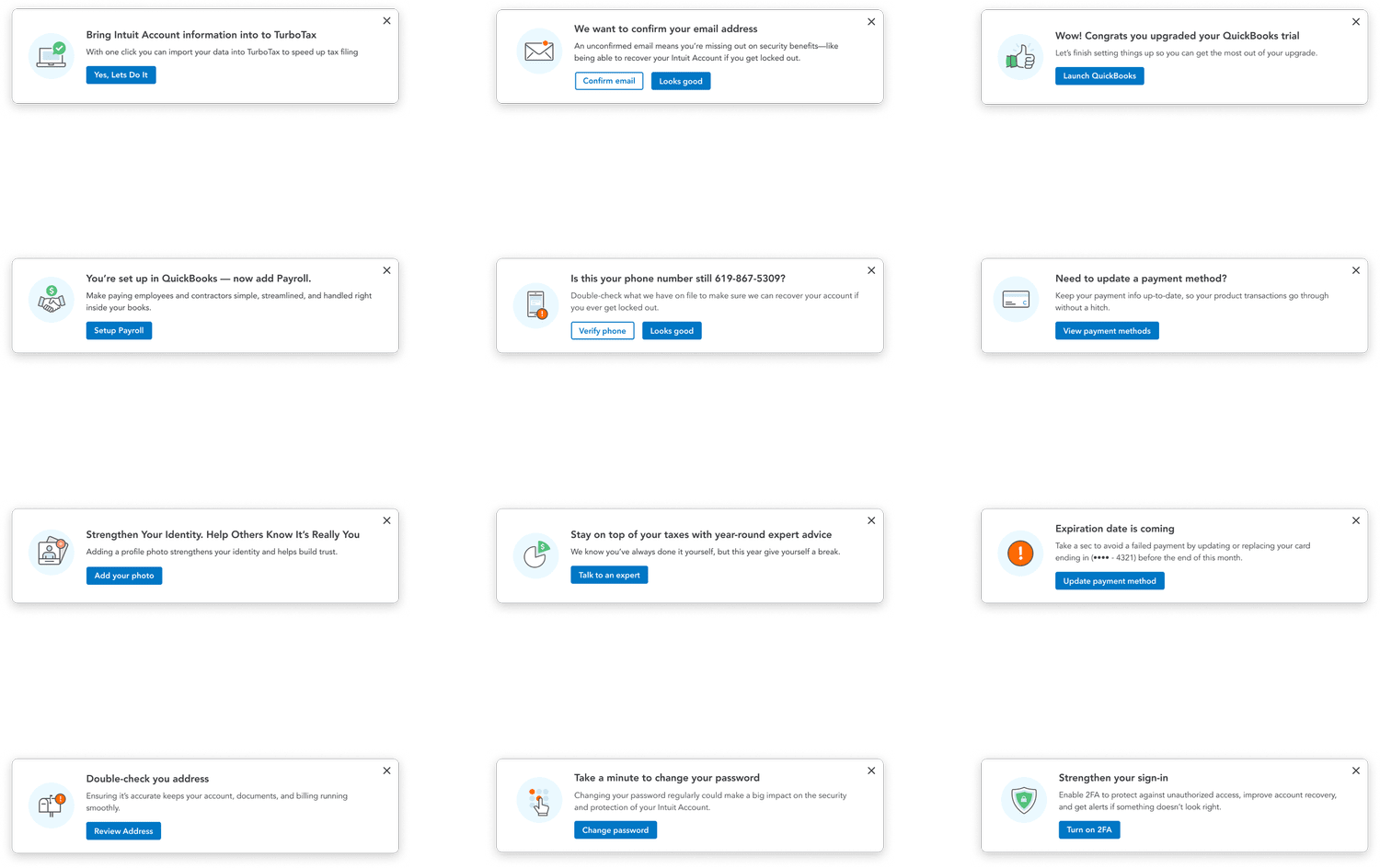
Designed New Account
Recommendations
The proposed account task recommendations introduced new, meaningful actions that expanded beyond the typical identity-only tasks.
The Task Recommendation
We Tested
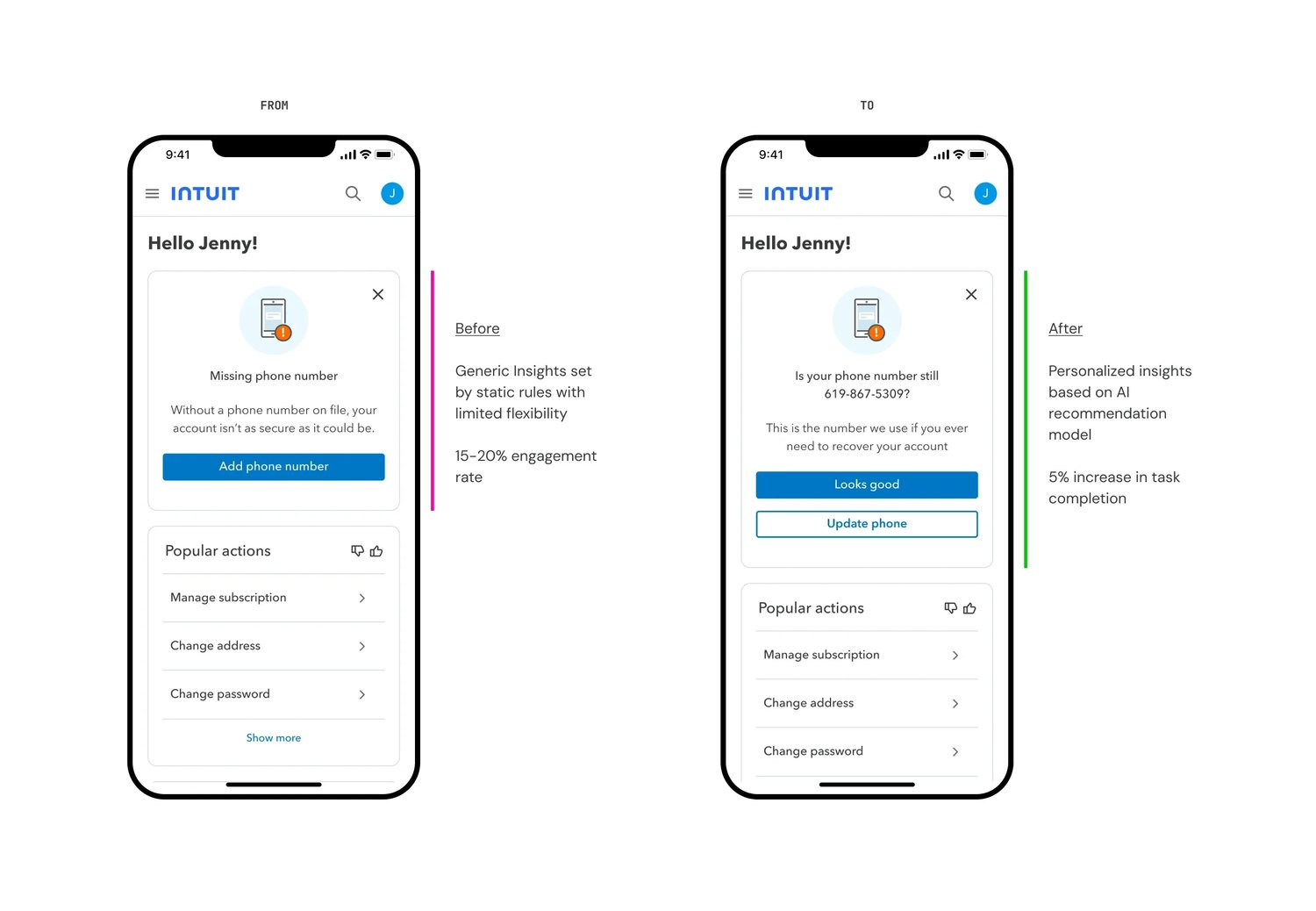
We identified a high-value identity task to redesign and measure that we were confident customers typically don’t ignore. By analyzing customer account behavior, we selected the “Confirm your phone number” recommendation as a strategic task to introduce to the AI/ML model. The “confirm your phone number” task plays a critical role in account security, recovery, and user trust, making it an ideal test case to improve relevance, clarity, and completion rates using ML-driven insights.
From > To
What AI/ML Brought To The Intuit Account Manager
Generic prompts shown to all users
Personalized recommendations based on behavior and account state
No explanation of why the prompt appeared
Clear contextual messaging explaining relevance
Repetitive experiences that led to frustration
Dynamic, adaptive recommendations that evolve over time
Research Insights
What We Learned
Through usability reviews, customer feedback data, and behavioral analytics, we identified three key patterns that informed the design; both from logic and the presentation of the AI recommendations:
Repetition drives dismissal - when customers see the same prompt multiple times, they assume its not relevant and stop trusting guidance. In pilot we observed a 30% drop in prompt dismissals (based on internal logs).
Context matters - customers respond better when the recommendation clearly explains why its being shown. “Customer feedback post-launch noted that the recommendation felt “clearer” and “more helpful” (verbatim quote taken from customer feedback after the pilot launch).
Identity-related tasks carry emotional friction - updating account details (phone, email, password) requires trust - customers need confidence that the prompt is legitimate and safe.

Takeaways
This project marked Intuit’s first foray into embedding AI/ML into customer-facing platform experiences. Instead of hard-coded rules, the system now adapts to customer history, surfacing the most relevant task at the optimal time. Our design work not only boosted engagement but also revealed insights about how customers perceive value from AI recommendations: trust, timing, and clarity matter more than volume.
The results validated our direction and pointed toward opportunities for even more personalized, adaptive experiences going forward. This project stretched me in new ways—I wasn’t sure at first if I could deliver at this level. But stepping into that uncertainty helped me deepen my skills in AI-driven design, cross-functional collaboration, and creating systems that scale.